|
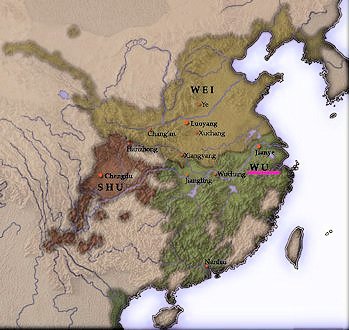
Five Dynasties and Ten Kingdoms Wu Kingdom - 902 to 937 - 35 Years Three Kingdoms period The three kingdoms were Wei, Shu, and Wu. To help further distinguish these states from other historical Chinese states of the same name, historians add a relevant character: Wei is also known as Cao Wei, Shu is also known as Shu Han, and Wu is also known as Dong Wu or Eastern Wu. The term Three Kingdoms itself is somewhat of a mistranslation, since each state was eventually headed not by kings, but by an emperor who claimed legitimate succession from the Han Dynasty. Although the translation Three Empires is more contextually accurate, the term Three Kingdoms has become standard among sinologists. The earlier, "unofficial" part of the period, from 184 to 220, was marked by chaotic infighting between warlords in various parts of China. The middle part of the period, from 220 and 263, was marked by a more militarily stable arrangement between three rival states, Cao Wei, Shu Han, and Eastern Wu. The later part of this period was marked by the collapse of the tripartite situation: first the destruction of Shu by Wei (263), then the overthrow of Wei by the Jin Dynasty (265), and the destruction of Wu by Jin (280). Although relatively short, this historical period has been greatly romanticised in the cultures of China, Japan, Korea, and Vietnam. It has been celebrated and popularised in operas, folk stories, novels and in more recent times, films, television series, and video games. The best known of these is undoubtedly the Romance of the Three Kingdoms, a novel dealing with the period that draws heavily on history. The authoritative historical record of the era is Chen Shou's Sanguo Zhi, along with Pei Songzhi's later annotations of the text. |
|
The Three Kingdoms period was one of the bloodiest in Chinese history. A population census during the late Eastern Han Dynasty reported a population of approximately 50 million,[2] while a population census during the early Western Jin Dynasty (after Jin re-unified China) reported a population of approximately 16 million.[2] However, the Jin dynasty's census was far less complete than the Han census, so these figures are in question. Technology advanced significantly during this period. Zhuge Liang invented the wooden ox, suggested to be an early form of the wheelbarrow, and improved on the repeating crossbow. A brilliant mechanical engineer known as Ma Jun, in Wei, is considered by many to be as brilliant as his predecessor Zhang Heng. He invented a hydraulic-powered, mechanical puppet theatre designed for Emperor Ming of Wei (Cao Rui), square-pallet chain pumps for irrigation of gardens in Luoyang, and the ingenious design of the South Pointing Chariot, a non-magnetic directional compass operated by differential gears. On to Wu Yue Kingdom Back to Ten Kingdoms Page Back to Home Page |
|