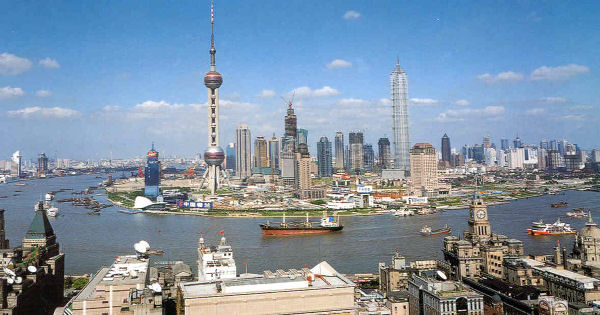
Shanghai Huangpu River 1

Shanghai Municipality Scenes

1. Shanghai Huangpu River

Compared to most other major cities in China, Shanghai has a brief history. During the Three Kingdom Period (220-265) the Shanghai area was part of the naval Kingdom of Wu. Under the Tang (618-907) and Song (1127-1279) Dynasties, it was an undistinguished port and fishing village built atop mud flats. Japanese envoys landed here en route to the Tang court at Xi'an.

Hi-Res Pic (76K)

On to Page 2     Back to Page 24

Back to Shanghai - Page 1

Under the Yuan Dynasty (1260-1378), it became a minor center for cotton spinning and weaving, partly as a result of innovative techniques. To defend against Japanese pirates, the Ming (1368-1644) Dynasty fortified the ramparts around the Old Town. During the 17th and 18th centuries, with the development of silk production in the surrounding areas, Shanghai became more of a trading center. By the early 1800s, it was a flourishing domestic port of some 50,000 people.

Opium Wars Significant growth did not occur until the arrival of Europeans in the mid-19th century. In 1842, near the end of the Opium War, Shanghai's garrison surrendered to the British Fleet. From that point until 1949 the city developed largely as an enclave for Western commercial interests in China. Lying off the sea and just upstream from the Yangzi, a river that could be navigated several hundred miles into the interior by oceangoing vessels, Shanghai provided a gateway to a vast internal market. Each of the major foreign powers claimed a section of the city. Residents of these infamous "international concessions" were exempt from the laws of China. Chinese were subjected to the added humiliation of being barred from free access to large portions of their own territory. A sign, preserved still today as a reminder, declares "No dogs or Chinese permitted on the Bund." By 1936, the Western population of Shanghai numbered 60,000.