|
Communist Military Leaders of the Korean War
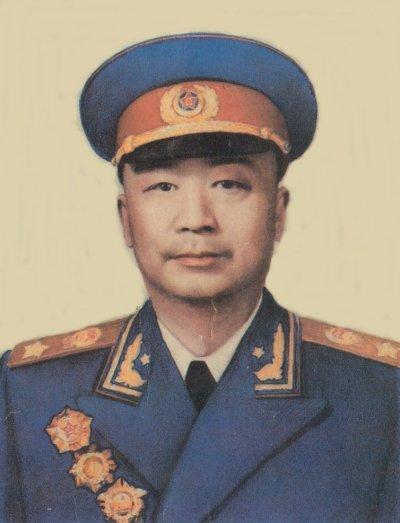
9. Marshal Nie Rongzhen
Background and History Nie Rongzhen (pronounced Nee eh Wrong Jung) was born in 1899 in Jiangjin County, Chongqing Province into a prosperous family, which sent him to France on a work-study program in 1920. There he fell under the influence of Zhou Enlai. Zhou Enlai recruited him in 1921 while a student in technical-scientific studies in Belgium. Nie joined the Communist Party in 1922. He went to Moscow, where he spent 1924 and 1925 in military study. He returned to China to work in the Whampoa Military Academy's Political Department where Zhou Enlai served as Director. He became the military commander of the CCP Guangdong Provisional Committee in 1926 and then secretary of the Military Commission of Hubei Provisional Committee. Proclamation of the People's Republic of China At the founding ceremony of the People's Republic of China on October 1st, 1949, General Nie led four divisions of troops past the reviewing stand. After the formation of the PRC, he was appointed as the mayor of Beijing, commander of the Beijing-Tianjin Garrison Command, and deputy chief of the PLA General Staff. He ran the General Staff because Zhou Enlai, as its chief, became preoccupied as the PRC's premier and Foreign Minister and also because the entire General Staff was Nie's former Northern Military Region Staff. In 1950, Nie became the acting chief of the General Staff. Activities in Korean War Nie Rongzhen was the acting chief of the PLA General Staff and vice chairman of the CCP Central Military Commission and the People's Revolutionary Military Committee during the Korean War. As one of the top military commanders and Mao Zedong's senior aide in Beijing, he took part in high command decision making, planning military operations, and shared the responsibility of war mobilization. He was named one of the Ten Chinese Marshals in 1955. Mao referred to him as "One of his Old Faithful." He died in 1992. |