|
Serbia
Background:
The Kingdom of Serbs, Croats, and Slovenes was formed in 1918; its name was
changed to Yugoslavia in 1929. Various paramilitary bands resisted Nazi
Germany's occupation and division of Yugoslavia from 1941 to 1945, but fought
each other and ethnic opponents as much as the invaders. The military and
political movement headed by Josip TITO (Partisans) took full control of
Yugoslavia when German and Croatian separatist forces were defeated in 1945.
In 1989, Slobodan MILOSEVIC became
president of the Serbian Republic and his ultranationalist calls for Serbian
domination led to the violent breakup of Yugoslavia along ethnic lines. In
1991, Croatia, Slovenia, and Macedonia declared independence, followed by
Bosnia in 1992. In February 2008, after nearly two years of inconclusive
negotiations, the UN-administered province of Kosovo declared itself
independent of Serbia - an action Serbia refuses to recognize. At Serbia's
request, the UN General Assembly (UNGA) in October 2008 sought an advisory
opinion from the International Court of Justice (ICJ) on whether Kosovo's
unilateral declaration of independence was in accordance with international
law. In a ruling considered unfavorable to Serbia, the ICJ issued an advisory
opinion in July 2010 stating that international law did not prohibit
declarations of independence. In late 2010, Serbia agreed to an EU-drafted UNGA
Resolution acknowledging the ICJ's decision and calling for a new round of
talks between Serbia and Kosovo.
Location:
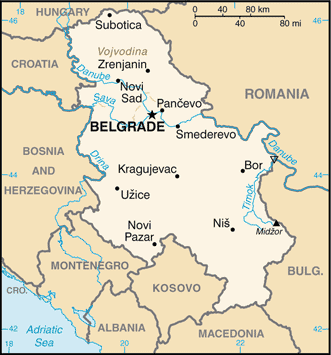
Southeastern Europe, between Macedonia and Hungary
Area: total: 77,474 sq km
land: 88,361 sq km.
Area - comparative: slightly smaller than South Carolina
Land boundaries: Total: 2,026 km , border countries: Bosnia and Herzegovina
302 km, Bulgaria 318 km, Croatia 241 km, Hungary 151 km, Kosovo 352 km,
Macedonia 62 km, Montenegro 124 km, Romania 476 km.
Climate and Terrain:
Climate: in the north, continental climate (cold winters and hot, humid
summers with well distributed rainfall); in other parts, continental and
Mediterranean climate (relatively cold winters with heavy snowfall and hot, dry
summers and autumns).
Terrain: extremely varied; to the north, rich fertile plains; to the east,
limestone ranges and basins; to the southeast, ancient mountains and hills.
Natural resources: oil, gas, coal, iron ore, copper, zinc, antimony, chromite,
gold, silver, magnesium, pyrite, limestone, marble, salt, arable land.
People:
Population: 7,276,604.
Ethnic groups: Serb 66%, Albanian 17%, Hungarian 3.5%, other 13.5%.
Religions: Serbian Orthodox 85%, Catholic 5.5%, Protestant 1.1%, Muslim 3.2%,
unspecified 2.6%, other, unknown, or atheist 2.6%.
Languages: Serbian (official) 88.3%, Hungarian 3.8%, Bosniak 1.8%, Romany
(Gypsy) 1.1%, other 4.1%, unknown 0.9%.
Government:
Government type: Republic.
Capital: Belgrade.
Independence: 5 June 2006 (from Serbia and Montenegro).
Economy overview:
Serbia has made progress in trade liberalization and enterprise restructuring
and privatization, but many large enterprises - including the power utilities,
telecommunications company, natural gas company, national air carrier, and
others - remain in state hands. Serbia has made some progress towards EU
membership, signing a Stabilization and Association Agreement with Brussels in
May 2008, and with full implementation of the Interim Trade Agreement with the
EU in February 2010, but a decision on candidate status has been postponed to
2012. Serbia is also pursuing membership in the World Trade Organization, and
accession negotiations are at an advanced stage.
Statistics:
Telephones - main lines in use: 3.11 million.
Telephones - mobile cellular: 9.9 million.
Radio broadcast stations: 153.
Internet users: 4.107 million.
Railways: Total: 3,379 km.
Highways: Total: 41,913 km, paved: 26,007, unpaved: 15,906 km.
Airports - with paved runways: 11, with unpaved runways: 18
Return to Visiting Locations
|