|
Avian Muscle System Return |
|
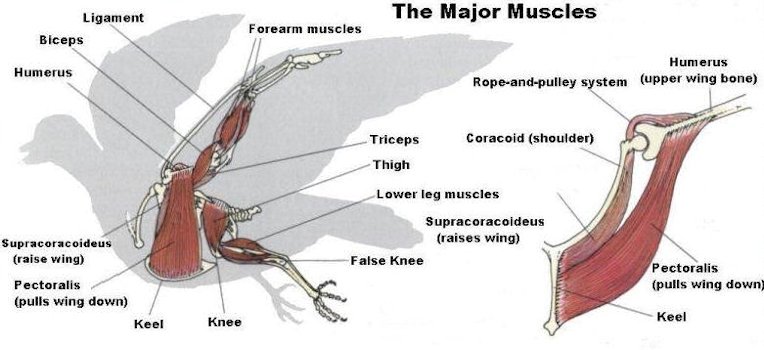
A bird has some 175 different muscles controlling the movements of its wings, legs, feet, tongue, eyes, ears, neck, lungs, sound-producing organs, body wall and skin. Collectively, the muscles are concentrated near the bird's center of gravity. Largest of all the muscles are the breast muscles, or pectorals. These muscles form the bulk of the fleshy mass in the breast and constitute about 15 to 20 percent of the bird's total body weight. They also provide the powerful downstroke of the wing and therefore bear most of the burden of supporting a bird in flight. The supracoracoideus -- the muscle that raises the wing -- acts as the antagonist to the pectorals. This muscle is located below the pectoral muscles ventrally (on the front side). Together, these two muscles constitute about 25 to 35 percent of a bird's body weight. Besides the supracoracoideus there are numerous other small muscles of the wing that allow a bird to control flight. Other muscles that play a critical role in flight are the skin muscles. The involuntary skin muscles, for example, which are attached to almost every feather follicle, can raise, lower, or move feathers sideways to assist a bird in its flight maneuvers. The trunk and tail muscles are few, but extremely mobile and complex. One of these muscles, the pygostyle, supports the tail feathers and controls their entire range of movement. "The thin, stringy muscles of the vertebral column control the elaborate lateral and ventral movements of the head and neck. Some of these muscles extend only from one vertebra to the next, and others link the movements of long series of vertebrae. |
|