|
Avian Respiratory System Return to Bird Anatomy Choices |
|
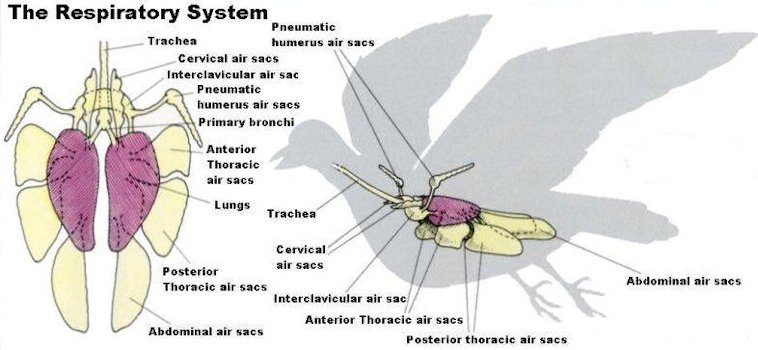
Ounce for ounce, a bird in flight requires more energy than a terrestrial mammal. Especially when migrating, birds fly at altitudes where oxygen is in such short supply that no mammal could possibly survive. Birds therefore have evolved a respiratory system that is fundamentally different from the mammalian respiratory system Like mammals, birds have two symmetrical lungs that are connected to a trachea (windpipe). But here the similarity ends. Mammalian lungs contain many bronchi (tubes), which leads to small sacs called alveoli. Because alveoli have only one opening, air can flow into and out of them, but it can never flow through them to the outside of a lung. These air sacs fill a large proportion of the chest and abdominal cavity, and also connect to the air spaces in the bones. Two primary bronchi, leading from the trachea, and a number of secondary bronchi, leading from the primary bronchi, feed air into the abdominal air sacs . Some of the secondary bronchi, which spread over the lower surface of each lung, channel air to the anterior air sacs. Also leading from the primary bronchi are between 7 and 10 dorsal bronchi, which spread over the back and sides of each lung, and ventral bronchi, which spread over the front of each lung. Finally there is a network of tertiary bronchi, which connects the ventral bronchi with the dorsal bronchi. Arising directly from the tertiary bronchi are air capillaries, which are responsible for the gas exchange between the ventilation system and the blood that transports oxygen to the body cells where it is needed for respiration. The passage of air through a bird's lungs is similar to water flowing through a sponge: Air flows directly through the lungs and into the adjacent air sacs. The theory is that the air sacs might very well function like bellows to drive air through the lungs. Unlike mammalian lungs, in which the volume of air changes with each inhalation and exhalation, avian lungs maintain a constant volume of air. Because of the air sacs, the lungs maintain a constant volume of air. Because of the air sacs, the lungs inflate but do not deflate to take in more oxygen: they hold air. If its lungs inflated and deflated with every breath, a bird in flight would be constantly gaining and losing altitude. Besides the advantage of keeping them on course, the avian respiratory system enables birds to maintain a higher energy level than mammals, because mammals lose energy just by breathing. Although the rate of respiration varies somewhat with the age of the bird, it is, in general, inversely proportional to body size -- the smaller the bird, the faster its breath rate. |
|