|
Bird Skeleton A Lightweight Skeleton |
|
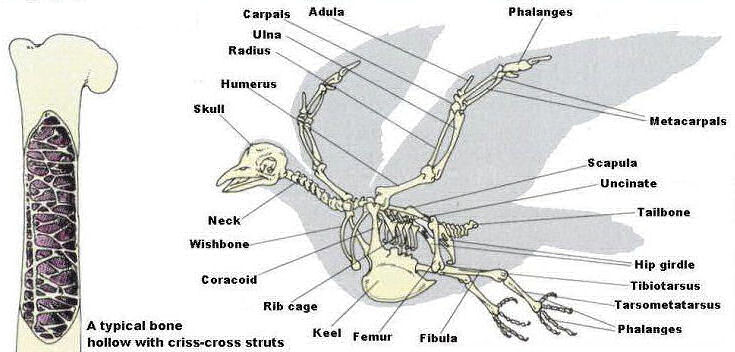
The fact that a pelican approximately 5 feet long weighing nearly 20 pounds has a skeleton weighing only 23 ounces indicates how perfectly a birds skeleton is adapted to its capacity for flight. The reason the skeleton is so lightweight is that many bones in a bird's skeleton are hallow. The hollow bones are honeycombed with air spaces and strengthened by crisscrossing struts. The number of hollow bones varies from species to species, though large gliding and soaring birds tend to have the most. In general, the more efficient fliers seem to have more bones that are hollow. A bird's streamlining for flight is perhaps best exemplified in the evolution of the skull, which is composed mainly of thin, hollow bones. A bird's skull is extremely light in proportion to the rest of its body due to elimination of a heavy jaw, jaw muscles, and teeth; the job of chewing has largely replaced by the gizzard. The skull usually represents less than 1 percent of a bird's total body weight. Although a present-day bird has fewer bones than its ancestors, its skeleton is strong enough for flight due to fusion of many of its bones. Forming rigid girders and platforms, fusion together for rigidity, and others are not, allowing for mobility. Vertebrae in the lower back are joined, as are the bones of the hip girdle, forming a light but strong plate that rests on the thigh bones and supports the bird when it is on the ground. Overlapping projections (similar to cartilage) near the backbone, called the uncinate processes, add strength to the rib cage. Formed by fusion of the collarbones at their base, the wishbone offers structural support for the wings. In flying birds the breast bone is fused to a deep keel (a longitudinal ridge of bone) that provides an anchor for the powerful flight muscles. Generally, the deeper the keel the more powerful the flight. In contrast to the rigidity of a bird's skeleton, the neck is extremely mobile. This allows the bird to see danger from any direction, catch prey, and preen its feathers, Flexibility is increased by the large number of neck vertebrae, which range from about from 11 to 25. In comparison, mammals -- even the giraffe -- have only 7 vertebrae. |
|