|
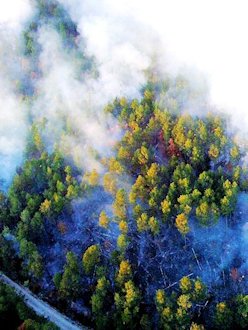
Fire Effect on Birds - Page 2 The upland areas of the southeastern coastal plain of North America used to be covered with forests of longleaf pines --- a tree that is especially adapted to grow in an environment that is burned every two to four years. Thick bark protects the growing tissue of the tree, and as the long needles burn they release moisture that cools the growing tip and allows a spurt of growth after the fire. Hardwood trees that grow in the bottomland areas are not all that tolerant of fire; they are eliminated from upland area when fire sweep0s through. On the other hand, hardwood trees are shade-tolerant, and pines are not. Young southern pine seedlings can survive only in the sunlight and thus cannot invade the shady recesses of moist bottomlands where the hardwoods reign. Similarly, if fire is excluded from the uplands by fire-control measures, hardwoods invade and young pines die in the shade. The parent pines, with crowns in the sun, witness the birth of a new ecosystem and the death of their own. Thus, southern pine forests are fire ecosystems; their existence is dependent on recurrent fire. Prescribed burning has become common practice in areas that would have been naturally burned a frequent intervals. Prescribed burning is crucial for the preservation of the birds of the pine forests. |
| Prescribed Burning | |