|
Birds -- Nest-Site Specialists
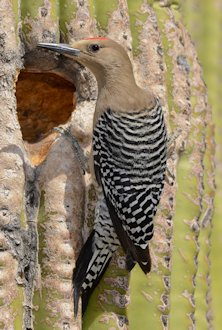
Among the birds with narrow nest-site requirements are those that nest in cavities. Some birds, like woodpeckers, are called primary cavity nesters because they excavate their own cavities. Secondary cavity nesters are totally dependent on finding a ready-made home -- often the work of one of the primary cavity nesters. Bluebirds, some swallows, wrens, flycatchers, kestrels, screech-owls, and vultures are secondary cavity nesters. Chickadees, titmice, and nuthatchers, often use ready-made cavities, but they can excavate their own if necessary. The deserts of the Southwest provide another example of nest-site specialization. The cavities that many species of woodpeckers excavate deteriorate rapidly as fungi invade the moist environments. As a result these primary cavity nesters must create new nests each year, and nest sites for secondary cavity nesters are in short supply. The Gila Woodpecker, on the other hand, displays a useful specialty. It excavates cavities in giant saguaro cacti. The sap of the saguaro forms a hard glaze on the inside of the cavity, so a bird can use the same hole for several years. A Gila Woodpecker does not have to excavate a nest as frequently as other species in the same area, and abandoned Gila Woodpecker nests provide habitable sites for secondary nesters. The Gila Woodpecker is, therefore, an essential component in the habitat of some southwestern deserts. |
| Gila Woodpecker |