|
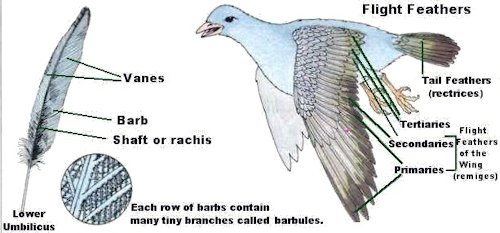
Bird Flight Feathers When you examine a contour feather you will find that the barbs are stuck together, forming a smooth surface. This is accomplished by tiny hooks on the barbules that interlock with the barbules of the adjoining barb, linking them together. If the barbules are disrupted, the bird can simply pass its bill though the feather to link them once again.
The contour feathers used for flight are known as
remiges
and
rectrices,
can be divided into three groups: primaries, secondaries and tertiaries. The
primary feathers propel the bird through the air.
|
|
|
They are the largest of the flight feathers and are the farthest away from the body, attached to the skin of the wing on the "hand." In most bird species there are 10 primary feathers on each wing. If these flight feathers are damaged or lost, a bird cannot fly. The secondary flight feathers run along the "arm" of the wing and sustain the bird in the air, giving it lift. The number of secondary feathers varies a great deal among the species. Birds that perch have 9 or 1o secondaries, but some species of grouse have as many as 20. Experiments have proven that if half of the secondaries are removed, a bird will still be able to fly, but some control will be lost. The Tertiaries are the few flight feathers and the numbers vary among species. The other main group of flight feathers are the tail feathers, or rectrices. The rectrices are mainly concerned with steering and balancing; they are used as a rudder, allowing the bird to twist and turn in flight. In addition, these feathers act as an efficient brake prior to landing. The number of rectrices varies among species, but is usually between 10 and 12. ⇦ On to Bristle Feather Return to Types of Bird Feathers On to Contour Feather ⇨ |
||