Great Bird Navigators

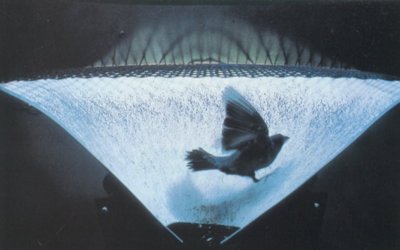
Conical Cage

Many migratory birds are remarkably faithful to previous nesting and overwintering places. Though a bird might be able to come close to these site merely by flying in a general direction during the course of migration, at some point more sophisticated navigating techniques must take over to guide the bird to its precise destination.

Many animals are able to find their way home. One way of doing this is to directly sense the goal -- to see, hear, or smell it. Another way is to memorize the details of the outward journey and then reverse the route based on an integration of that information. Birds, however, apparently rely on a completely different process to find their way.

To understand the nature of the problem, imagine yourself in the following situation: You have been blindfolded and taken by a circuitous and unfamiliar route to a place you have never been before. There, in a forest without any view if distant landmarks, the blindfold is removed. You are left alone with a compass and a map, and you need to find your way back home.

From the ink pad on the bottom of this orientation cage, a bird makes tracks to the northeast, a course it would normally fly during spring migration. By rotating visual cues, it is possible to trick the bird into selecting the wrong direction.

Unfortunately, before you can use the compass for information about direction, you must determine where you are in relation to your goal -- you need to find your location on the map so you will know where you are in relation to home. A bird in an unfamiliar setting is quickly able to gain the information it needs to orient itself and navigate its way back home. To explain bird navigation, we have what is known as the "map-and-compass" theory.

The compass component of this theory gives direction --- north, south, east, west; the map component tells the bird where it is, or gives locality. Scientists have learned a great deal more about the compass component than they have about mapping. They know that birds have several means of determining compass directions, but unfortunately, they still have no satisfactory explanation for how birds use biological "maps" to guide then to a precise location from an unfamiliar starting point.


Back to Bird Migration and Navigation Choices     Back to Oregon Birds