|
Getting the Migration Timing Right - Page 2
Somewhere in North America, there is probably some kind of migratory movement of birds every day. But spring migration, the mass movement of birds toward their breeding grounds, happens with predictable timing each year. The precise local timing varies, of course, with latitude and elevation. Early spring might mean early February in the southernmost states, late March or early April in the north, or even May in the far north and high mountains. Some birds of prey also start to migrate in early spring. Bald eagles, rough-legged hawks and red-shouldered hawks are actively moving north even while wintry conditions still prevail. Other surprisingly early migrants include purple martins, returning from South America and reaching Florida and Texas by late January and making it to northern states by the end of March. The great northward flood of songbirds that have wintered in the Tropics, including warblers, tanagers, buntings, grosbeaks, orioles, vireos and thrushes, occurs primarily during April and May, filling North American woodlands with color, song and activity. For many birders, warblers are particular favorites; there are several places in the country where you can see more than 30 species of these tiny, colorful gems during the course of the season. |
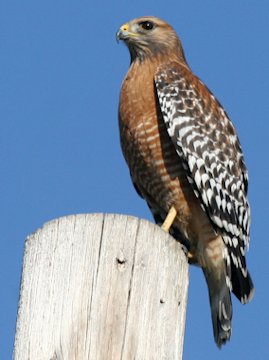
| Red-shouldered Hawk |