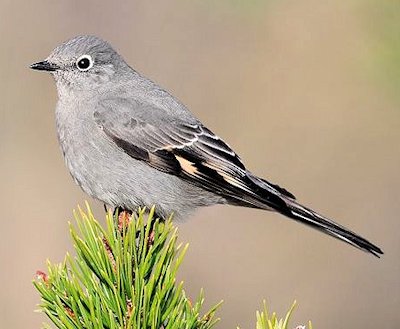
Townsend's Solitare

Why do birds Migrate?

Food, water, protective cover, and a sheltered place to nest and breed are basic to a bird's survival. But the changing seasons can transform a comfortable environment into an unlivable one -- the food and water supply can dwindle or disappear, plant cover can vanish, and competition with other animals can increase.

Most wild animals face the problem of occupying a habitat that is suitable for only a portion of the year. Fortunately, however, nature has provided methods for coping with the situation. One method, known as hibernation, involves entering a dormant state during the winter season. The other method, known as migration, involves escaping the area entirely. Because of the powers of flight, most birds adapt to seasonal changes in the environment by migrating; only a few birds species, such as the Common Poorwill, hibernate.

In North America, the ratio of migratory to nonmigratory birds varies greatly from region to region. In high arctic regions (northern Alaska, northern Canada, and Greenland), where many shorebirds and water fowl nest, the entire population often consists of migratory birds who are only there during the summers.

In North America, the ratio of migratory to nonmigratory birds varies greatly from region to region. In high arctic regions (northern Alaska, northern Canada, and Greenland), where many shorebirds and water fowl nest, the entire population often consists of migratory birds who are only there during the summers. In the forest and open country of eastern United States, over 80 percent of the nesting land birds are migratory, spending the winter in more hospitable southern climates. There is a similar high percentage of south-migrating birds in inland areas of the West. However, in areas where the climate is more equable, like the Pacific Coast, more species are nonmigratory; in tropical regions at least 80 percent of the birds are nonmigratory.

In the Rockies and Sierras of the West, migration often consists of moving from the high to low elevations. Rosy Finches, Townsend's Solitaires, and Mountain Quail perform these movements quite regularly whereas others, such as Clark's Nutcracker, are much more erratic.

Back to Bird Migration Choices     Back to Oregon Birds     Back to Home Page
The annual fall migration of the Townsend's Solitaire may consist merely of descending a few thousand feet from a high mountain forest to the shelter of a wooded valley.

Some migration schedules do not always closely follow seasonal changes in the weather. For example, since the vegetative food supply of nomadic species such as the crossbills, redpolls, and Pine Grosbeaks fluctuates in abundance from year to year, these birds migrate in some winters and not in others. In contrast, insect-eating birds such as warblers, vireos, and flycatchers that live in the far north have no choice but to migrate from their summer habitats, since their food supply always disappears from sight in winter; their migration therefore tends to involve long distances and regular timing.